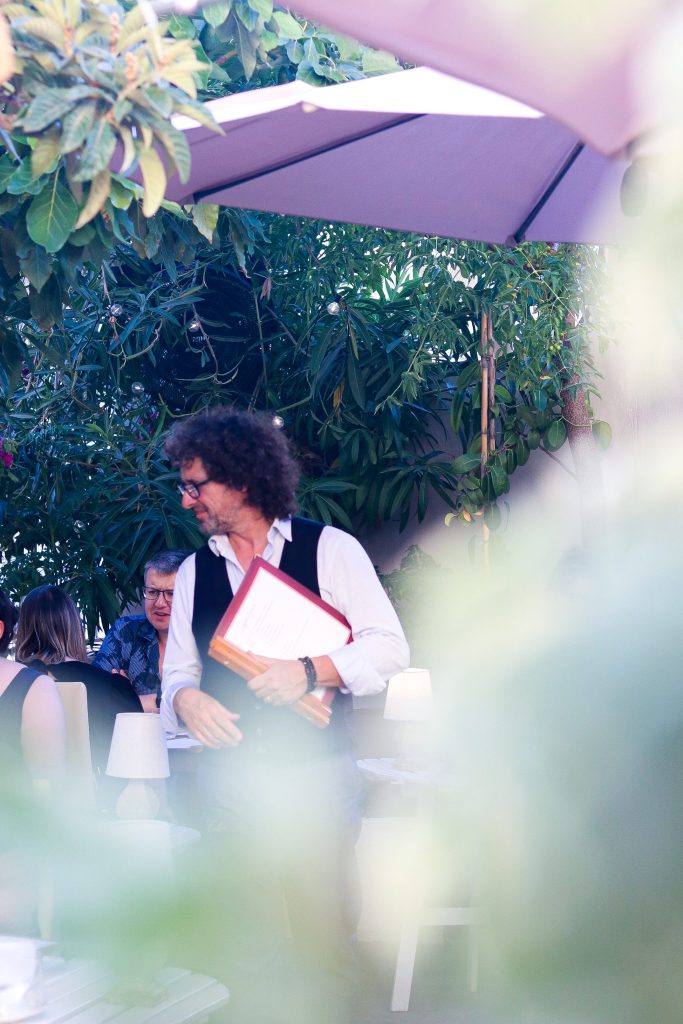



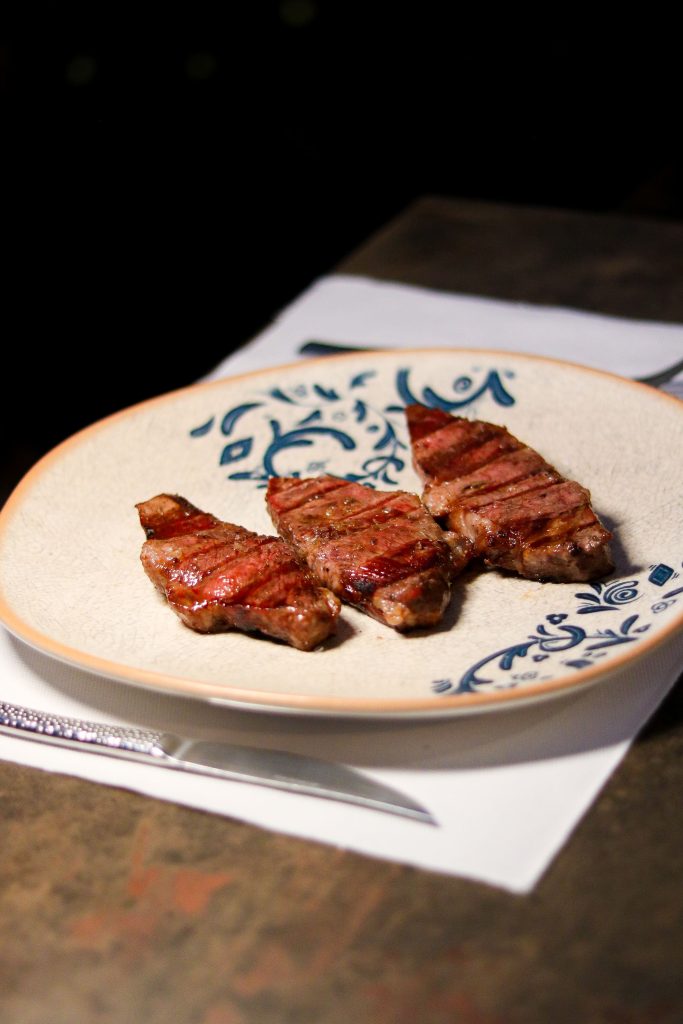
In short: steak tartare is a classic of French cuisine made with raw beef, minced or very finely cut, dressed with condiments such as mustard, capers, gherkin, shallot and egg yolk. Its origin mixes legend and gastronomy: from the Tatar horsemen of the steppes to Escoffier’s recipe book in the early twentieth century. In classic dining rooms it is prepared at the table, in front of the guest, a ritual we keep alive at Caliu with knife-cut beef tenderloin.
There are dishes you eat and dishes you experience. Steak tartare belongs to the second group.
When it is prepared as tradition dictates, at the table and in front of the guest, it becomes a little performance: the sound of the knife, the order of the ingredients, the moment the yolk goes in, the question about how spicy you like it.
In this guide we explain what steak tartare is, where it comes from, what goes in it, how to recognise a good one and why preparing it in front of the guest makes so much sense.
And at the end, we explain how we do it at Caliu, in La Carihuela, where it is on our menu under a name that says it all: old-school steak tartare.
What steak tartare is
Steak tartare, also written steak tartar or called tartar steak, is a preparation of raw beef, minced or cut into very small dice, dressed with a series of condiments and served cold.
There is no cooking. All the flavour depends on two things: the quality of the meat and the balance of the dressing.
That is why it is one of the most demanding dishes of classic cooking. There is no sauce to hide poor raw material and no heat to correct a mistake.
Steak tartare, tartar and tartare: are they the same?
All three forms are used. Tartare is the original French spelling; tartar is the most common adaptation in Spanish. Both refer to the same dish.
Today the word tartare is also used for other raw preparations cut into dice, such as tuna or salmon tartare. But when people say steak tartare, it is always beef.
The origin of steak tartare: between legend and recipe book
Few recipes have such a novel-like history. And as often happens, legend and facts do not always match.
The legend of the Tatar horsemen
The most popular version says that the Tatars, nomadic peoples from the steppes of Central Asia who were part of the Mongol armies, put pieces of raw meat under their saddles. After hours of riding, the meat was tender and ready to eat.
It is a very appealing story, but historians consider it more myth than reality. Many believe it was a way of portraying these peoples as barbarians in European eyes.
The first literary references
There are old mentions of raw meat being eaten by peoples of the East in the accounts of travellers such as Marco Polo.
Centuries later, Jules Verne described in his novel Michael Strogoff, published in 1875 and 1876, a dish of minced meat with egg. Some historians believe Parisian restaurateurs were inspired by that description.
Escoffier and the birth of the modern dish
The decisive step came from Auguste Escoffier, the great French chef considered the father of modern cooking.
In the early twentieth century, a dish of minced raw beef was known in Europe as steak à l’américaine. In the editions of his Le Guide Culinaire from the early twenties, Escoffier describes a variant, steak à la tartare, served without yolk and accompanied by tartar sauce.
In other words, the name probably does not come directly from the Tatars, but from the sauce it was served with.
Over time, the two versions merged. By 1938, the Larousse Gastronomique already described steak tartare as minced raw beef with egg yolk, with no mention of tartar sauce.
From the Parisian brasserie to the world
Throughout the twentieth century, steak tartare became a classic of French brasseries and of the great restaurants with table service across Europe. That is also where the custom of preparing it at the table, on a side trolley called a guéridon, was born.
Today it is a universal dish, with versions in France, Belgium, Switzerland, Germany, Poland, Spain and many other countries.
Steak tartare in Spain
In Spain, steak tartare arrived through the great French and international restaurants during the twentieth century, and for decades it was a dish reserved for the most classic dining rooms.
In recent years it has had a real revival. It is one of the most searched food terms online in Spain, with tens of thousands of searches every month, and it appears on more and more menus, from modern taverns to chef-driven restaurants.
Many Spanish chefs have reinterpreted it with local produce: aged Galician beef, homemade pickles, extra virgin olive oil or touches of paprika.
What has been lost in many places is the tableside ritual. That is why finding a steak tartare prepared in front of the guest, as it used to be done in the great dining rooms, is still something special.
What goes into a classic steak tartare
There is no single recipe, but there is a recognisable base. These are the most common ingredients in the classic version.
| Ingredient | Role |
|---|---|
| Beef tenderloin | The base: tender, lean and clean-tasting |
| Egg yolk | Adds richness and binds everything together |
| Dijon mustard | Gentle heat and depth |
| Capers | A salty, sour touch |
| Gherkins | Acidity and crunch |
| Shallot or onion | Freshness and a little bite |
| Parsley | Herbal notes and colour |
| Worcestershire sauce | Umami and spice |
| Tabasco or pepper | Heat to taste |
| Salt, pepper and oil | Final adjustment |
Some versions add ketchup, cognac, anchovies or lemon juice. Every house has its formula, and part of the charm is adjusting it to the taste of whoever is going to eat it.
Usual accompaniments
Steak tartare is usually served with chips, toasted bread, thin toasts or a green salad. In Belgium and France, chips are almost compulsory.
The meat: the secret of a good steak tartare
If there is a golden rule, it is this: a steak tartare is never better than the meat it is made with.
Why tenderloin
Tenderloin is the most tender cut of beef. It has very little intramuscular fat and hardly any connective tissue, so it can be eaten raw with a soft, pleasant texture.
Other cuts, such as topside or silverside, are also used, but tenderloin is the classic choice in the best restaurants.
Knife-cut versus machine-minced
It is one of the big differences between an ordinary tartare and an excellent one.
- Machine-minced: the meat is crushed and slightly warmed as it passes through the mincer. The texture becomes pastier and juices are lost.
- Knife-cut: the meat is cut into very small dice, without crushing the fibres. Texture, juice and flavour are preserved. Every bite has body.
Cutting by knife takes more time and skill, but the result is incomparable.
Freshness and the cold chain
As it is raw meat, freshness and temperature are essential. The piece must always be kept refrigerated and cut just before serving, never hours in advance.
Why it is prepared at the table
Preparing steak tartare in front of the guest is not just about show, although it is one. There are very specific reasons for it.
1. Absolute freshness
The tartare is mixed at the last moment, just before eating. The meat does not wait, does not oxidise and reaches your mouth at its best.
2. Adjusted to each guest’s taste
Not everyone likes it the same way. Some prefer more mustard, others more heat, others no onion. Preparing it at the table means each tartare can be adapted to the person eating it.
3. Transparency
The guest sees the meat, sees the ingredients and sees how it is prepared. Nothing is hidden. It is a very direct way of showing confidence in the product.
4. The craft of table service
Guéridon service is one of the finest arts of classic hospitality. It requires knowledge, precision and a way with guests. Keeping it up means keeping a tradition alive.
5. Experience
And yes, it is also an experience. It turns a dish into a moment that is remembered and shared.
What the tableside ritual looks like, step by step
Every restaurant has its way of doing it, but the classic ritual follows a recognisable sequence.
Step 1: presenting the ingredients
The waiter arrives at the table with the meat already cut and the condiments laid out in small dishes. It is the moment to explain the dish and ask about preferences.
Step 2: the base of the dressing
In a wide bowl, the base is worked first: yolk, mustard, sauces and oil. It is mixed until it forms a light emulsion.
Step 3: the aromatics
The chopped ingredients go in: shallot, capers, gherkin and parsley. This is when they are dosed to the guest’s taste.
Step 4: the meat
The meat is added and gently mixed, coating each dice without crushing it. The idea is to spread the dressing without breaking the texture.
Step 5: tasting and adjusting
In classic service the guest is offered a taste and salt, pepper or heat are corrected if needed.
Step 6: plating
Finally, the tartare is presented on the plate, usually shaped into a round, with its accompaniment.
The whole process takes a few minutes, but it is one of those moments that makes a dinner different.
Steak tartare at Caliu: old school
At Caliu, steak tartare is one of our most ordered dishes and one we take most care over. We call it old-school steak tartare, because we want to keep the ritual of classic hospitality alive.
- Meat: premium beef tenderloin.
- Cut: by knife, to preserve the texture.
- Preparation: in front of the guest, at the table.
- Portions: full 200 g for 35 €, or half 100 g for 19 €.
The half portion is ideal if you want to try it as a starter or share it before a main course. The full portion works perfectly as a main.
You can see the rest of what we offer on our menu. And if you fancy something lighter along the same lines, we also have salmon tartare with crème fraîche and dill.
Tip: if you have clear preferences, such as not too spicy or no onion, tell the dining room team before they start. That is what the ritual is for.
Which wine to pair with steak tartare
Steak tartare is a cold, intense dish with acidity, so it suits several pairings.
- Light, fresh reds: with little oak and good acidity, so they do not overpower the meat.
- Dry rosés: a very good choice in summer.
- Full-bodied whites: with some lees ageing, to stand up to the dressing.
- Sparkling wines: a brut cava or champagne cleanses the palate between bites.
If you want to try something local, Málaga province has reds from Ronda and the Serranía with very good acidity. Ask for advice in the dining room.
Steak tartare variations around the world
- Filet américain (Belgium): creamier, with mayonnaise, served with chips.
- Tatar (Poland): with yolk, onion, pickled cucumber and pickled mushrooms.
- Mett (Germany): minced raw pork, seasoned and spread on bread.
- Yukhoe (Korea): raw beef in strips with soy sauce, sesame and pear.
- Kibbeh nayyeh (Middle East): raw meat with bulgur wheat and spices.
- Chef versions: with truffle, Japanese pickles, emulsions or smoked touches.
Safety: what you should know before ordering
Steak tartare is a raw meat dish, and as such it is worth knowing some recommendations.
The Spanish Agency for Food Safety and Nutrition (AESAN) recommends that pregnant women avoid raw or undercooked meat, such as steak tartare or carpaccio, because of the risk of toxoplasmosis and other infections.
It is also not generally advised for people with weakened immune systems or for young children.
For everyone else, the risk is greatly reduced when the dish is made in a restaurant with good practices: fresh meat from a trusted supplier, the cold chain, clean utensils and preparation to order.
If you have any doubts or a particular situation, consult your doctor.
How to recognise a good steak tartare
- Colour: deep, bright red, never brown or dull.
- Texture: visible dice, not a uniform paste.
- Temperature: cold, but not icy.
- Smell: clean, with no sour or strange notes.
- Balance: the dressing accompanies the meat, it does not cover it.
- Preparation: to order. Be wary of a tartare that arrives instantly with no visible preparation.
Common mistakes with steak tartare
- Using poor-quality meat: the most serious mistake. There is no way to hide it.
- Preparing it in advance: the meat oxidises and loses texture.
- Too much dressing: the tartare should taste of meat, not mustard.
- Mincing it too finely: the texture that makes it special is lost.
- Serving it warm: it must be cold to keep its freshness.
Curious facts about steak tartare
- In the early twentieth century it was called steak à l’américaine, although it has nothing to do with the United States.
- The name tartare probably comes from the tartar sauce it was served with, not from the Tatars.
- The trolley it is prepared on in the dining room is called a guéridon.
- In Belgium, filet américain used to be made with horse meat.
- It is one of the few dishes of classic French cooking that is always finished at the very last second.
Frequently asked questions about steak tartare
Which meat is used for steak tartare?
The classic is beef tenderloin, as it is the most tender and lean cut.
Does steak tartare contain raw egg?
The classic version usually includes egg yolk, which adds richness. Some variants leave it out.
Is it safe to eat steak tartare?
For most healthy people, yes, if it is made with fresh meat and good practices. AESAN recommends that pregnant women avoid it.
Why is it prepared at the table?
To guarantee freshness, adjust the dressing to each guest’s taste and keep the tradition of table service alive.
Where to eat steak tartare in Torremolinos?
At Caliu, in Montemar, La Carihuela, we prepare it at the table with premium knife-cut beef tenderloin. Dinner only, from 7 pm to 11:30 pm.
How much does steak tartare cost at Caliu?
The full 200 g portion costs 35 € and the half 100 g portion, 19 €.
Conclusion
Steak tartare is much more than raw meat with a dressing. It is history, technique, produce and the craft of table service, all in one dish.
When it is done well, with good knife-cut meat prepared to order, it is one of the great pleasures of classic cooking.
If you want to experience it the old-school way, we are waiting for you in La Carihuela. Book your table at Caliu and let us prepare it in front of you.